
Confidence Without Aggression
Parents often face a difficult question: “How do I teach my child to stand up for themselves without teaching them to look for a fight?” Aikido offers an unusual answer. Children learn a real martial art — including movement, throws, controls, falling, self-defense, discipline and traditional dojo etiquette — but they do so in an art that does not make aggression or competition the goal. Instead of learning to trade blows with an opponent, students learn to recognize an attack, move rather than freeze, maintain their balance, disrupt the attacker’s balance and bring the situation under control. Aikido teaches children that being peaceful does not mean being passive.
Learning to Deal With Physical Pressure
One of the most valuable things martial arts training can give a child is experience dealing with physical pressure in a safe environment. Being grabbed, pushed or confronted can cause a child to tense up, panic or react impulsively. In Aikido class, students gradually become accustomed to physical contact while learning how to move and respond. They practice what happens when someone grabs an arm. They learn how to move when another person enters their space. They discover how balance changes when someone pushes or pulls them. And they learn that their first response does not have to be panic or retaliation. Over time, unfamiliar situations become familiar physical problems that they have practiced solving.
Confidence That Comes From Experience
We often tell children to “be confident,” but genuine confidence is difficult to teach with words alone. Aikido gives children experiences from which confidence can grow. A student learns to fall safely and get back up. A technique that seemed impossible begins to work. A smaller child discovers that good movement and timing can affect a larger partner. A student who was uncomfortable being grabbed learns that they can stay composed and continue moving. Each accomplishment is small, but those accomplishments accumulate.
The goal is not to convince children that they can win every confrontation. It is to help them become more comfortable with their own bodies, more aware of what is happening around them and more confident in their ability to respond.
Self-Defense Without Making Fighting the Goal
Aikido is a martial art, and its techniques come from responses to physical attacks. Children learn to deal with grabs, pushes and strikes using movement, balance, throws and controls. But the purpose of training is not to encourage children to prove themselves by fighting. Aikido emphasizes avoiding unnecessary conflict and using appropriate control when physical action becomes necessary. Students learn that there is an important difference between having the ability to respond and looking for an opportunity to use it.
That distinction can be especially valuable for children. We want them to know that they do not have to accept being pushed around. At the same time, we want them to understand that strength includes judgment, restraint and self-control.
Cooperation Instead of Competition
Aikido is unusual among martial arts because there are no tournaments and no opponent to defeat. Students train with one another rather than against one another. One child attacks while the other practices a technique, and then they exchange roles. Each student is responsible for helping the other learn safely. This does not mean the training is passive. A partner still gives the student a genuine physical problem to solve. As students improve, attacks can become more committed and techniques more challenging. But success does not require another child to lose. Students learn that they can become stronger and more capable while helping the people around them improve at the same time.
Learning How to Fall — and Get Back Up
An important part of Aikido is ukemi, the art of safely receiving a technique and falling. Children learn how to protect themselves when they lose their balance, how to roll and fall correctly and how to get back to their feet. Ukemi makes Aikido practice possible, but it also teaches something larger: falling is not failure. You fall. You recover. You try again. That lesson is repeated hundreds of times on the mat.
Focus, Etiquette and Self-Control
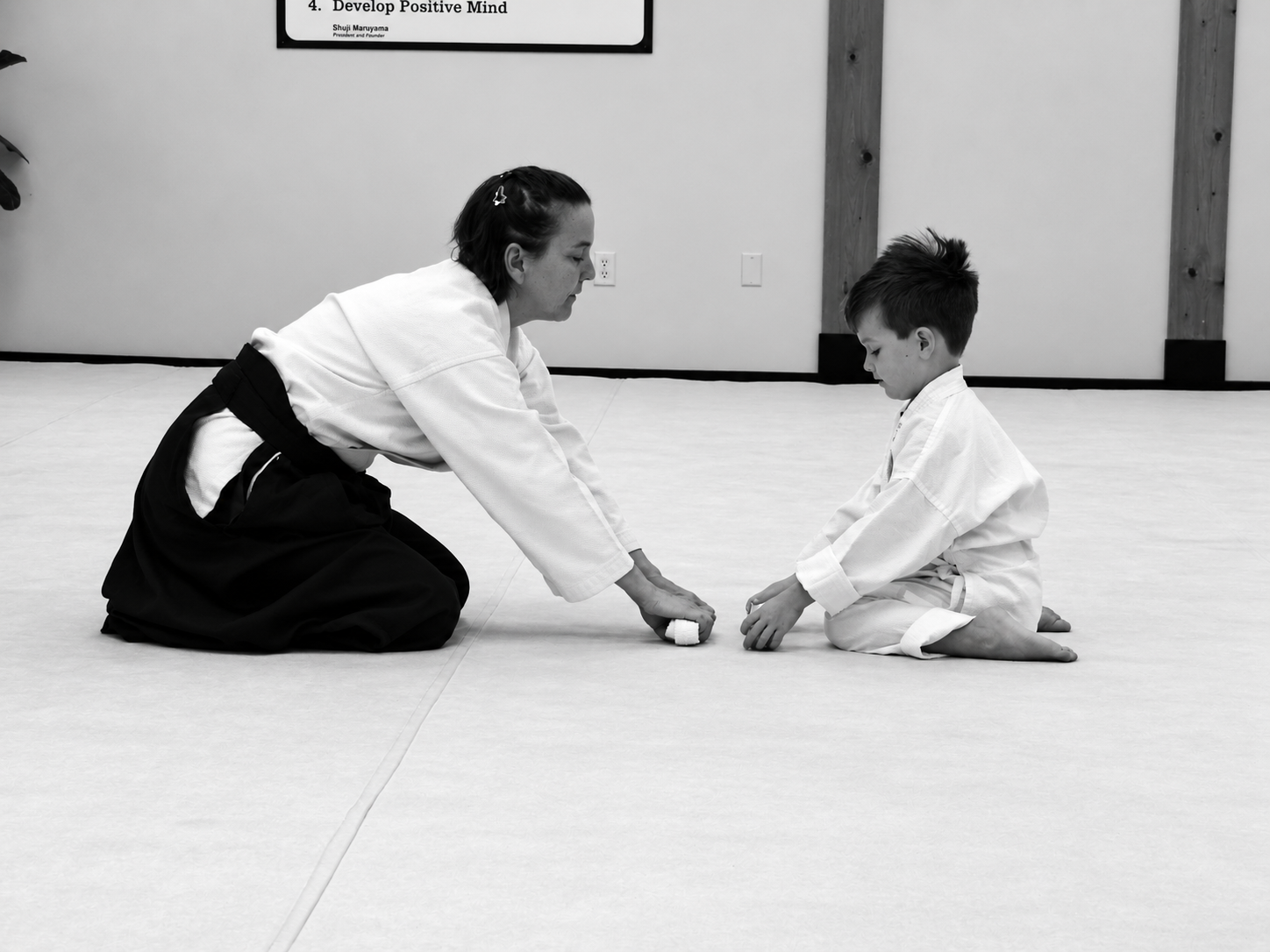
Aikido training also introduces children to the traditions and etiquette of a Japanese martial art. Students learn how to enter and leave the mat properly, bow to their instructors and training partners, listen to instruction, take turns and accept responsibility for another person’s safety. Techniques require attention. Children have to watch closely, remember a sequence of movements and then reproduce it with a partner. The discipline comes from learning to control themselves — their bodies, their attention and eventually their reactions.
Strong Does Not Have to Mean Aggressive
This may be the most important lesson Youth Aikido has to offer. Children are often presented with two choices: be nice and back down, or be tough and fight back. Aikido presents another possibility. You can be calm without being weak. You can be assertive without being aggressive. You can protect yourself without becoming the aggressor. And sometimes the strongest response is simply refusing to be pulled into someone else’s anger. Aikido gives children a place to explore those ideas physically rather than merely hearing adults talk about them.
What Children Develop Through Aikido
Regular training helps children develop:
- Balance and coordination
- Body awareness
- Safe falling and rolling skills
- Focus and concentration
- Self-discipline
- Respect and dojo etiquette
- Comfort dealing with appropriate physical contact
- Self-defense skills
- Confidence based on experience
- The ability to remain calmer under pressure
- Cooperation and responsibility toward training partners
Most importantly, children learn that martial ability and aggression are not the same thing.
Come See a Youth Class
The best way to decide whether Aikido is right for your child is to see a class. New students do not need previous martial arts experience, and they are not expected to know the terminology, etiquette or techniques before they begin. We teach those things one step at a time.
Youth Aikido classes are currently held Monday and Wednesday from 5–6 p.m. Come watch a class, meet the instructors and see how children train.
302-757-1056
quietstormkids@gmail.com